Does image SEO still matter in 2026? What I measured
Yes — image SEO still matters in 2026, but not for the reason most guides give you. Search engines can see your images now. What they still can't do is know what an image means without words. And the machines people increasingly search with, from Google's AI results to ChatGPT, are even hungrier for that text layer than classic search ever was. Most websites aren't feeding it: in WebAIM's 2026 survey of the top one million home pages, more than half had images missing alternative text.
What image SEO actually means in 2026
Image SEO used to be a short checklist: alt text for Google Images, compressed files for page speed, maybe a sitemap if you were thorough.
The checklist is still there. What changed is who's reading.
When someone asks ChatGPT or Perplexity a question, or gets an AI-generated answer at the top of Google, those systems assemble responses from content they can parse. Text parses. Images parse only through the words attached to them: the alt text, the filename, the caption, the structured data. An image with none of those is a blank spot in the machine's understanding of your page.
That's the new layer, and it has a name: Generative Engine Optimization. GEO is the practice of making your content machine-readable for AI answer engines: for images, that means alt text, descriptive filenames, structured data like ImageObject schema, and context files like llms.txt. Same craft as image SEO, higher stakes, new readers.
So in 2026, image SEO is two jobs with one toolset: helping Google rank your images, and helping AI systems understand them. Everything in this post serves both.
Can't Google just see my images now?
Partly, yes. And if you're skeptical of this whole topic, that's the right question to ask.
Modern vision models are genuinely good. Show Google a photo and it can tell you there's a person, a desk, a laptop. Object recognition is a solved-enough problem that "the machine is blind without alt text" (a line you'll still find in SEO guides) simply isn't true anymore.
Here's what vision doesn't give you: meaning. A person at a desk could be your CEO, your customer, or a stock photo you bought for $12. The pixels are identical. Which one it is (and whether the image is worth indexing, ranking, or citing) comes from the words around it. Recognition is what the model sees; relevance is what you tell it.
That's why alt text and structured data survive in Google's own image SEO documentation to this day, not as accessibility charity, but as the mechanism for connecting an image to a query. And it's why the gap matters more for AI answers than for classic search: an answer engine composing a response doesn't browse your page like a human. It works from the text layer. No text layer, no seat at that table.
I named my company's whole thesis after this gap, so yes, I'm biased. The difference is I measured it — next section.
What the data says
I wanted to know what the metadata gap actually looks like on a site that should know better. So I picked one: anthropic.com, the company behind Claude, one of the AI systems this whole post is about.
Methodology, so you can judge the numbers: in July 2026 I crawled anthropic.com with Vizibly, my own audit tool. 10 pages discovered sitemap-first, 85 images found and scored. One site, one crawl, a case study rather than a survey.
What came back:
- 46% of images had no alt text at all. Not weak alt text — none.
- 89% had no AI-readable context: no structured data, no entity information, nothing an answer engine could parse beyond the pixels.
- Overall site score: 55/100.
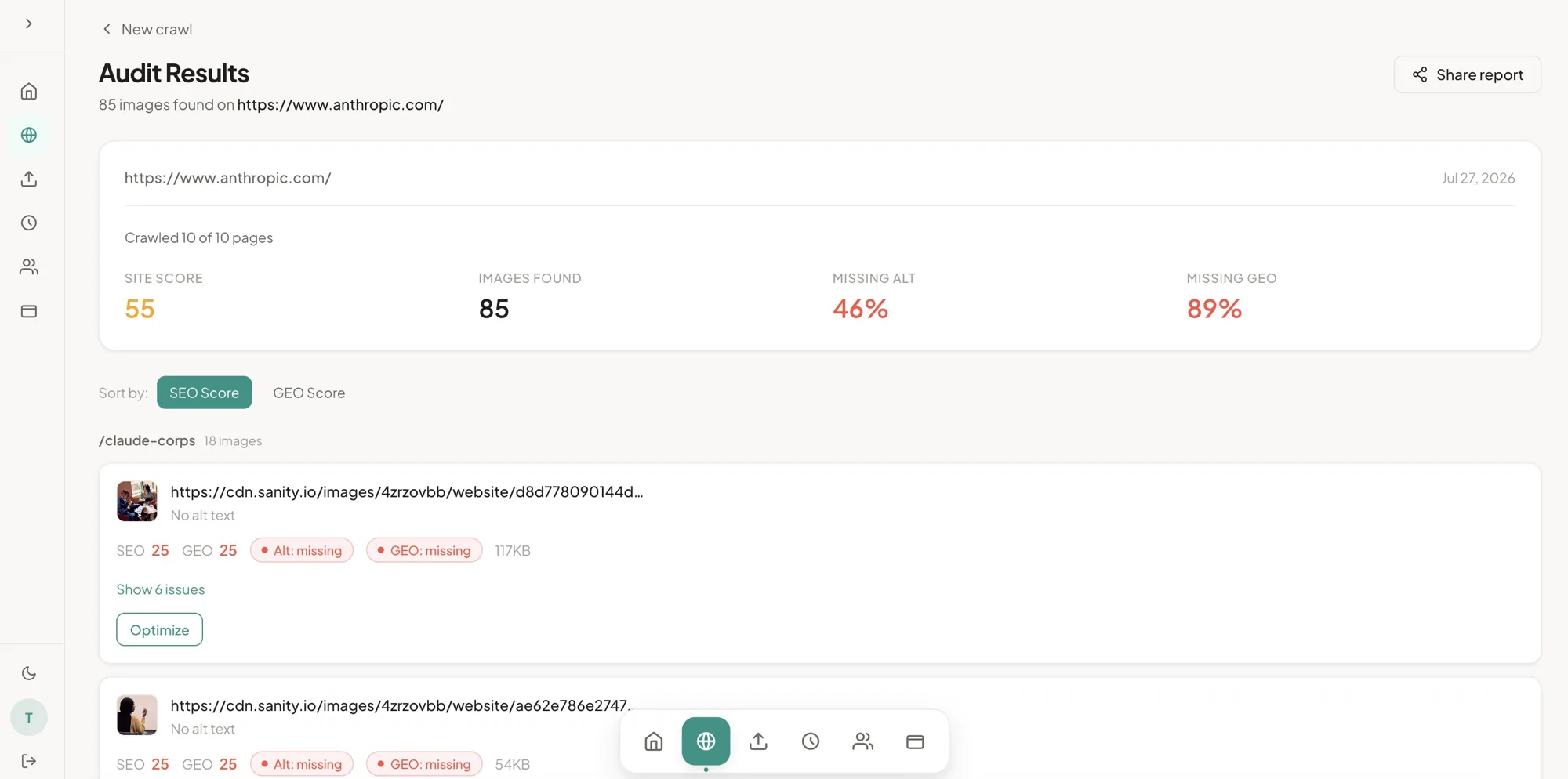
To be clear about what this means and doesn't mean: this is not negligence, and it's not a callout. Anthropic's site is well-built by any normal standard. That's precisely the point: if the company building the AI hasn't optimized its images for AI search, it's because almost nobody has. The practice is that new. There's no industry habit yet, no checklist item in most CMS workflows, no one whose job it is.
The wider data agrees. WebAIM's 2026 analysis of the top one million home pages (an accessibility study, independent of anyone selling SEO tools) found more than half had images missing alternative text, at an average of over ten such images per page. That number has barely moved in years of annual surveys. The web's image layer is under-described, persistently, at every level of the market.
Which is either depressing or an opportunity, depending on which side of the audit you're on: if everyone's images are unreadable, being the site whose images aren't is a cheap edge (in a channel your competitors haven't noticed exists).
The accessibility angle nobody budgets for
Here's the part that turns a nice-to-have into a deadline: in Europe, describing your images isn't optional anymore. The European Accessibility Act's requirements have applied since 28 June 2025, and alt text on meaningful images sits squarely inside what it expects.
Screen readers have always needed that text. A blind user doesn't get your hero image: they get whatever you wrote in the alt attribute, or silence. That's the original reason alt text exists, long before anyone said "GEO" out loud.
The convenient part is that it's the same text layer. The alt attribute a screen reader reads aloud is the alt attribute Google indexes and an answer engine parses. Write it once and three audiences are served: the person using assistive tech, the search crawler, and the AI. You rarely get a fix that pays off in three directions at once.
So if the SEO argument doesn't move you, the compliance one might, and the accessibility one should. And the regulatory pressure is only growing. But the honest framing is simpler than any of that: an image that can't be read is a problem for people first and machines second, and the remedy is identical for both.
What actually moves the needle
None of this is exotic. It's a short list, mostly text, and you can do all of it yourself. Here's what actually earns the machine's attention, roughly in order of payoff-to-effort.
Write alt text a stranger could picture. Alt text describes what an image shows and why it's on the page. "Coffee" is generic and forgettable; "barista pouring a heart into a flat white on a café counter" is specific: subject, action, setting. The specific version maps to something a person might actually search, which is exactly what a crawler or answer engine is trying to match.
Name the file like it matters. A filename is metadata you set once and then forget. img_20240312_094521.jpg tells a machine nothing; latte-art-flat-white-cafe.webp says what the picture is before a single word of alt text is read. Rename before upload. It's the cheapest signal on this list.
Add ImageObject structured data. Structured data is a small block of machine-readable JSON that labels an image explicitly: its caption, its subject, its license. ImageObject is the schema.org type built for exactly this, and it's in Google's own image best practices. Vision can guess what's in a picture; structured data tells the machine without it having to guess, which is what answer engines prefer to work from.
Compress so the page actually loads. Heavy images slow pages, and slow pages lose both rankings and readers. Converting to a modern format like WebP fixes most of it. On one representative CMS-export image I measured a 52% reduction in file size. But be honest about the range: an already-optimized image might save almost nothing, while a raw, oversized original can save far more.
Give crawlers an image sitemap. An image sitemap points search engines straight at the images you want found, instead of hoping they're discovered by crawling the page. It doesn't make an image better — it makes sure it's seen. Low effort, and it removes an excuse for a crawler to miss your work.
Publish an llms.txt. llms.txt is an emerging convention: a plain-text file that hands AI systems a clean, structured summary of your site's content and context. Adoption isn't universal yet, so treat it as a bet on direction rather than a guarantee: a context layer written for machines that read instead of browse. Cheap to add now, plausibly useful later.
What nobody can promise you (including me)
Now the part most tools won't put in writing. Nobody can promise you'll be cited by ChatGPT, quoted by Perplexity, or surfaced in Google's AI answers. Not me, not anyone.
The reason is unglamorous: those systems don't publish citation data. There's no dashboard that tells you which AI answers referenced your page, and no clean before-and-after you could run. Any vendor showing you "X% more AI citations" is showing you a number they can't source, which by my own rules means it isn't a number at all.
So I won't sell you the outcome. What I'll sell (and what you can check without me) is the input. Your images either carry machine-readable metadata or they don't. Alt text is present or missing. Structured data validates or it doesn't. Files are compressed or they're bloated. Every one of those is verifiable on your own site, today, by you.
That's the line I hold: Vizibly makes the structural layer readable to Google and AI search, and I let the outcomes speak for themselves. Promising the citation is marketing. Making the image readable is the work — and it's the only half anyone can honestly stand behind.
You don't have to take my word for any of it. That's rather the point. Run the same audit I ran on anthropic.com against your own site, see which of your images the machines can actually read, and go from there. It's free, and you'll be looking at your own numbers, not mine.
Related reading: Optimized vs. unoptimized images: what actually changes — one real image, every metadata field documented before and after.